FaradayModel Tutorial
Trey V. Wenger (c) February 2025
Here we demonstrate the basic features of the FaradayModel model. The FaradayModel predicts Stokes Q, U, and Faraday depth spectra by decomposing the Faraday depth spectrum into a series of Gaussian “clouds”. Please review the bayes_spec documentation and tutorials for a more thorough description of the steps outlined in this tutorial: https://bayes-spec.readthedocs.io/en/stable/index.html
[2]:
# General imports
import os
import pickle
import time

import matplotlib.pyplot as plt
import arviz as az
import pandas as pd
import numpy as np
import pymc as pm

print("pymc version:", pm.__version__)

import bayes_spec
print("bayes_spec version:", bayes_spec.__version__)

import bayes_pol
print("bayes_pol version:", bayes_pol.__version__)

# Notebook configuration
pd.options.display.max_rows = None
pymc version: 5.20.0
bayes_spec version: 1.7.2+4.gfef408d
bayes_pol version: 0+untagged.1.gabd3ba0.dirty
Simulating Data
To test the model, we must simulate some data. We can do this with FaradayModel, but we must pack a “dummy” data structure first.
[30]:
from bayes_spec import SpecData

# spectral axis definition
freq_axis = np.linspace(1.1e9, 1.4e9, 300) # Hz
lam2_axis = (2.99792458e+08/freq_axis[::-1])**2.0 # m2

# Uniform lam2 axis for Fourier transform
lam2_chan = np.diff(lam2_axis).min()
lam2_regular_axis = np.arange(lam2_axis.min(), lam2_axis.max()+lam2_chan, lam2_chan)
lam2_window_width = np.ptp(lam2_axis)

# data noise can either be a scalar (assumed constant noise across the spectrum)
# or an array of the same length as the data
rms = 1.0 # uJy

# brightness data. In this case, we just throw in some random data for now
# since we are only doing this in order to simulate some actual data.
stokesQ = rms * np.random.randn(len(lam2_axis)) # uJy
stokesU = rms * np.random.randn(len(lam2_axis)) # uJy

# Faraday depth spectral axis, wraps at pi (rad/m2)
faraday_depth_axis = np.fft.fftshift(np.fft.fftfreq(len(lam2_regular_axis), d=lam2_chan/np.pi))

# Faraday depth spectrum (uJy)
stokesQ_interp = rms * np.random.randn(len(lam2_regular_axis)) # uJy
stokesU_interp = rms * np.random.randn(len(lam2_regular_axis)) # uJy
complex_pol = stokesQ_interp + 1.0j*stokesU_interp
faraday_depth = np.fft.fftshift(np.fft.fft(complex_pol, norm="backward"))/len(lam2_regular_axis)

obs_Q = SpecData(
    lam2_axis,
    stokesQ,
    rms * np.ones_like(stokesQ),
    xlabel=r"$\lambda^2$ (m$^2$)",
    ylabel=r"$Q$ ($\mu$Jy)",
)
obs_U = SpecData(
    lam2_axis,
    stokesU,
    rms * np.ones_like(stokesU),
    xlabel=r"$\lambda^2$ (m$^2$)",
    ylabel=r"$U$ ($\mu$Jy)",
)
obs_faraday_depth_abs = SpecData(
    faraday_depth_axis,
    np.abs(faraday_depth),
    rms / np.sqrt(len(lam2_regular_axis)),
    xlabel=r"$\phi$ (rad m$^{-2}$)",
    ylabel=r"$|F(\phi)|$ ($\mu$Jy)",
)
print("Faraday depth noise: ", obs_faraday_depth_abs.noise[0])
dummy_data = {
    "Q": obs_Q,
    "U": obs_U,
    "faraday_depth_abs": obs_faraday_depth_abs,
}

# Plot the simulated data
fig, axes = plt.subplots(len(dummy_data), figsize=(12, 8), layout="constrained", squeeze=False)
for ax, dataset in zip(axes.ravel(), dummy_data.values()):
    ax.plot(dataset.spectral, dataset.brightness, "k.")
    ax.set_xlabel(dataset.xlabel)
    ax.set_ylabel(dataset.ylabel)
Faraday depth noise: 0.04805693313322127

Now that we have a dummy data format, we can generate a simulated observation by evaluating the model for a given set of parameters.
[31]:
from bayes_pol import FaradayModel

# Initialize and define the model
n_clouds = 3 # number of cloud components
model = FaradayModel(
    dummy_data,
    lam2_window_width=lam2_window_width,
    n_clouds=n_clouds,
    seed=1234,
    verbose=True
)
model.add_priors(
    prior_polarized_intensity = 100.0,
    prior_faraday_depth_mean = [0.0, 1000.0],
    prior_faraday_depth_fwhm = 10.0,
)
model.add_likelihood()

sim_params = {
    "polarized_intensity": [75.0, 150.0, 50.0],
    "faraday_depth_mean": [1000.0, -500.0, 2000.0],
    "faraday_depth_fwhm": [5.0, 20.0, 0.0],
    "pol_angle0": [-0.4, 0.2, 0.5],
}
sim_obs = {
    key: model.model[key].eval(sim_params, on_unused_input="ignore")
    for key in dummy_data.keys()
}

# Save simulated data

obs_Q = SpecData(
    lam2_axis,
    sim_obs["Q"],
    rms * np.ones_like(stokesQ),
    xlabel=r"$\lambda^2$ (m$^2$)",
    ylabel=r"$Q$ ($\mu$Jy)",
)
obs_U = SpecData(
    lam2_axis,
    sim_obs["U"],
    rms * np.ones_like(stokesU),
    xlabel=r"$\lambda^2$ (m$^2$)",
    ylabel=r"$U$ ($\mu$Jy)",
)
obs_faraday_depth_abs = SpecData(
    faraday_depth_axis,
    sim_obs["faraday_depth_abs"],
    rms / np.sqrt(len(lam2_axis)),
    xlabel=r"$\phi$ (rad m$^{-2}$)",
    ylabel=r"$|F(\phi)|$ ($\mu$Jy)",
)
data = {
    "Q": obs_Q,
    "U": obs_U,
    "faraday_depth_abs": obs_faraday_depth_abs,
}

# Plot the simulated data
fig, axes = plt.subplots(len(data), figsize=(12, 8), layout="constrained", squeeze=False)
for ax, dataset in zip(axes.ravel(), data.values()):
    ax.plot(dataset.spectral, dataset.brightness, "k.")
    ax.set_xlabel(dataset.xlabel)
    ax.set_ylabel(dataset.ylabel)

Model Definition
Finally, with our model definition and (simulated) data in hand, we can explore the capabilities of FaradayModel. Here we create a new model with the simulated data.
[32]:
# Initialize and define the model
model = FaradayModel(
    data,
    lam2_window_width=lam2_window_width,
    n_clouds=n_clouds,
    seed=1234,
    verbose=True
)
model.add_priors(
    prior_polarized_intensity = 100.0,
    prior_faraday_depth_mean = [0.0, 1000.0],
    prior_faraday_depth_fwhm = 10.0,
)
model.add_likelihood()
[33]:
# Plot model graph
model.graph().render('faraday_model', format='png')
model.graph()
[33]:
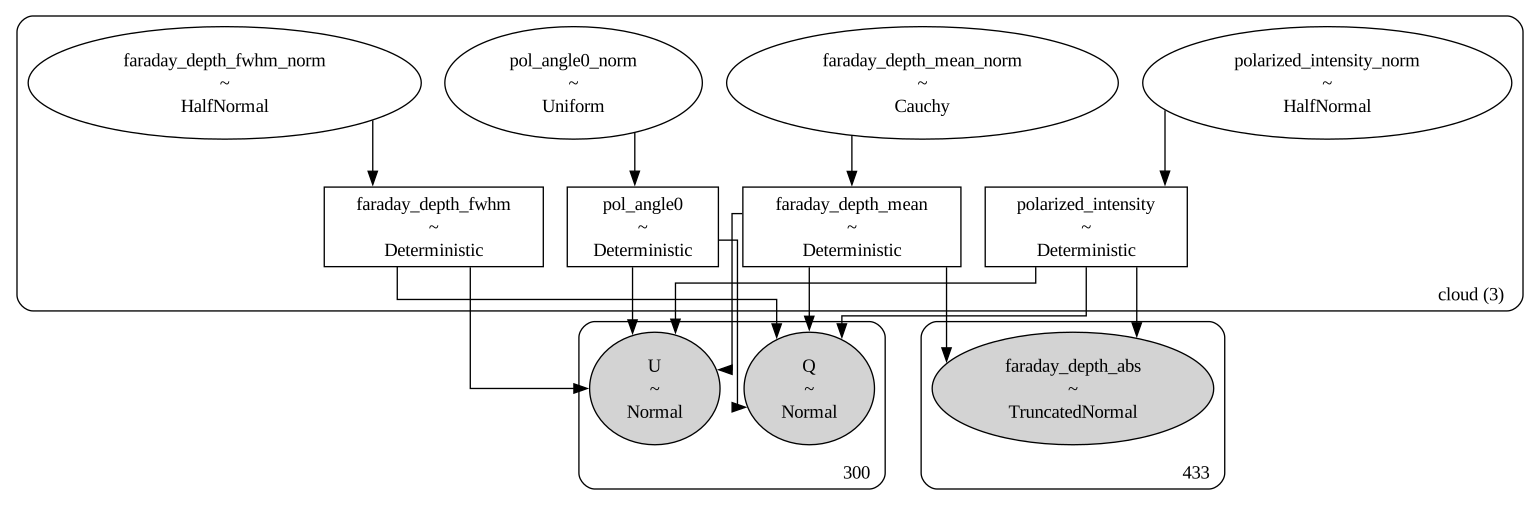
[34]:
# model string representation
print(model.model.str_repr())
polarized_intensity_norm ~ HalfNormal(0, 1)
 faraday_depth_mean_norm ~ Cauchy(0, 1)
 faraday_depth_fwhm_norm ~ HalfNormal(0, 1)
         pol_angle0_norm ~ Uniform(-3.14, 3.14)
     polarized_intensity ~ Deterministic(f(polarized_intensity_norm))
      faraday_depth_mean ~ Deterministic(f(faraday_depth_mean_norm))
      faraday_depth_fwhm ~ Deterministic(f(faraday_depth_fwhm_norm))
              pol_angle0 ~ Deterministic(f(pol_angle0_norm))
       faraday_depth_abs ~ TruncatedNormal(f(polarized_intensity_norm, faraday_depth_mean_norm), <constant>, 0, inf)
                       Q ~ Normal(f(polarized_intensity_norm, pol_angle0_norm, faraday_depth_mean_norm, faraday_depth_fwhm_norm), <constant>)
                       U ~ Normal(f(polarized_intensity_norm, pol_angle0_norm, faraday_depth_mean_norm, faraday_depth_fwhm_norm), <constant>)
We check that our prior distributions are reasonable by drawing prior predictive checks. Each colored line is a simulated “observation” with parameters drawn from the prior distributions. You should check that these simulated observations at least somewhat overlap your actual observation (black line).
[35]:
from bayes_spec.plots import plot_predictive

# prior predictive check
prior = model.sample_prior_predictive(
    samples=100,  # prior predictive samples
)
_ = plot_predictive(model.data, prior.prior_predictive)
Sampling: [Q, U, faraday_depth_abs, faraday_depth_fwhm_norm, faraday_depth_mean_norm, pol_angle0_norm, polarized_intensity_norm]

[36]:
from bayes_spec.plots import plot_pair

_ = plot_pair(
    prior.prior, # samples
    model.cloud_deterministics,
    labeller=model.labeller, # label manager
)

Variational Inference
We can approximate the posterior distribution using variational inference.
[37]:
start = time.time()
model.fit(
    n = 100_000, # maximum number of VI iterations
    draws = 1_000, # number of posterior samples
    rel_tolerance = 0.01, # VI relative convergence threshold
    abs_tolerance = 0.01, # VI absolute convergence threshold
    learning_rate = 0.01, # VI learning rate
)
end = time.time()
print(f"Runtime: {(end-start)/60.0:.2f} minutes")
Convergence achieved at 68600
Interrupted at 68,599 [68%]: Average Loss = 1.3909e+06
Runtime: 0.57 minutes
[38]:
# ignore transition and state dependent parameters
pm.summary(model.trace.posterior)
arviz - WARNING - Shape validation failed: input_shape: (1, 1000), minimum_shape: (chains=2, draws=4)
[38]:
| mean | sd | hdi_3% | hdi_97% | mcse_mean | mcse_sd | ess_bulk | ess_tail | r_hat | |
|---|---|---|---|---|---|---|---|---|---|
| faraday_depth_fwhm[0] | 6.457 | 0.050 | 6.370 | 6.547 | 0.002 | 0.001 | 982.0 | 1023.0 | NaN |
| faraday_depth_fwhm[1] | 20.435 | 0.016 | 20.406 | 20.466 | 0.001 | 0.000 | 954.0 | 671.0 | NaN |
| faraday_depth_fwhm[2] | 4.294 | 0.095 | 4.136 | 4.487 | 0.003 | 0.002 | 862.0 | 873.0 | NaN |
| faraday_depth_fwhm_norm[0] | 0.646 | 0.005 | 0.637 | 0.655 | 0.000 | 0.000 | 982.0 | 1023.0 | NaN |
| faraday_depth_fwhm_norm[1] | 2.044 | 0.002 | 2.041 | 2.047 | 0.000 | 0.000 | 954.0 | 671.0 | NaN |
| faraday_depth_fwhm_norm[2] | 0.429 | 0.009 | 0.414 | 0.449 | 0.000 | 0.000 | 862.0 | 873.0 | NaN |
| faraday_depth_mean[0] | 999.734 | 0.005 | 999.726 | 999.743 | 0.000 | 0.000 | 735.0 | 734.0 | NaN |
| faraday_depth_mean[1] | -499.862 | 0.012 | -499.887 | -499.841 | 0.000 | 0.000 | 881.0 | 983.0 | NaN |
| faraday_depth_mean[2] | 2000.064 | 0.011 | 2000.044 | 2000.084 | 0.000 | 0.000 | 1073.0 | 978.0 | NaN |
| faraday_depth_mean_norm[0] | 1.000 | 0.000 | 1.000 | 1.000 | 0.000 | 0.000 | 735.0 | 734.0 | NaN |
| faraday_depth_mean_norm[1] | -0.500 | 0.000 | -0.500 | -0.500 | 0.000 | 0.000 | 881.0 | 983.0 | NaN |
| faraday_depth_mean_norm[2] | 2.000 | 0.000 | 2.000 | 2.000 | 0.000 | 0.000 | 1073.0 | 978.0 | NaN |
| pol_angle0[0] | -0.380 | 0.001 | -0.381 | -0.379 | 0.000 | 0.000 | 1045.0 | 1023.0 | NaN |
| pol_angle0[1] | 0.179 | 0.000 | 0.179 | 0.179 | 0.000 | 0.000 | 914.0 | 838.0 | NaN |
| pol_angle0[2] | 0.502 | 0.001 | 0.500 | 0.504 | 0.000 | 0.000 | 973.0 | 900.0 | NaN |
| pol_angle0_norm[0] | -0.759 | 0.001 | -0.761 | -0.757 | 0.000 | 0.000 | 1045.0 | 1023.0 | NaN |
| pol_angle0_norm[1] | 0.358 | 0.000 | 0.357 | 0.359 | 0.000 | 0.000 | 914.0 | 838.0 | NaN |
| pol_angle0_norm[2] | 1.004 | 0.002 | 1.001 | 1.007 | 0.000 | 0.000 | 973.0 | 900.0 | NaN |
| polarized_intensity[0] | 74.848 | 0.052 | 74.752 | 74.941 | 0.002 | 0.001 | 755.0 | 816.0 | NaN |
| polarized_intensity[1] | 149.472 | 0.058 | 149.362 | 149.573 | 0.002 | 0.001 | 961.0 | 981.0 | NaN |
| polarized_intensity[2] | 49.920 | 0.057 | 49.805 | 50.020 | 0.002 | 0.001 | 972.0 | 989.0 | NaN |
| polarized_intensity_norm[0] | 0.748 | 0.001 | 0.748 | 0.749 | 0.000 | 0.000 | 755.0 | 816.0 | NaN |
| polarized_intensity_norm[1] | 1.495 | 0.001 | 1.494 | 1.496 | 0.000 | 0.000 | 961.0 | 981.0 | NaN |
| polarized_intensity_norm[2] | 0.499 | 0.001 | 0.498 | 0.500 | 0.000 | 0.000 | 972.0 | 989.0 | NaN |
[39]:
posterior = model.sample_posterior_predictive(
    thin=100, # keep one in {thin} posterior samples
)
_ = plot_predictive(model.data, posterior.posterior_predictive)
Sampling: [Q, U, faraday_depth_abs]

Posterior Sampling: MCMC
We can sample from the posterior distribution using MCMC.
[40]:
start = time.time()
model.sample(
    init = "advi+adapt_diag", # initialization strategy
    tune = 1000, # tuning samples
    draws = 1000, # posterior samples
    chains = 6, # number of independent chains
    cores = 6, # number of parallel chains
    init_kwargs = {"rel_tolerance": 0.01, "abs_tolerance": 0.01, "learning_rate": 0.01}, # VI initialization arguments
    nuts_kwargs = {"target_accept": 0.8}, # NUTS arguments
)
end = time.time()
print(f"Runtime: {(end-start)/60.0:.2f} minutes")
Initializing NUTS using custom advi+adapt_diag strategy
Convergence achieved at 68600
Interrupted at 68,599 [68%]: Average Loss = 1.3909e+06
Multiprocess sampling (6 chains in 6 jobs)
NUTS: [polarized_intensity_norm, faraday_depth_mean_norm, faraday_depth_fwhm_norm, pol_angle0_norm]
Sampling 6 chains for 1_000 tune and 1_000 draw iterations (6_000 + 6_000 draws total) took 56 seconds.
Adding log-likelihood to trace
Runtime: 1.75 minutes
[41]:
model.solve(kl_div_threshold=0.1)
GMM converged to unique solution
[42]:
print("solutions:", model.solutions)

# ignore transition and state dependent parameters
var_names = [
    param for param in model.cloud_deterministics
    if not set(model.model.named_vars_to_dims[param]).intersection(set(["transition", "state"]))
]
pm.summary(model.trace.posterior, var_names=var_names + model.hyper_deterministics + model.baseline_freeRVs)
solutions: [0]
[42]:
| mean | sd | hdi_3% | hdi_97% | mcse_mean | mcse_sd | ess_bulk | ess_tail | r_hat | |
|---|---|---|---|---|---|---|---|---|---|
| polarized_intensity[0] | 74.972 | 0.056 | 74.869 | 75.077 | 0.001 | 0.001 | 4901.0 | 4300.0 | 1.0 |
| polarized_intensity[1] | 150.030 | 0.058 | 149.920 | 150.134 | 0.001 | 0.001 | 5168.0 | 4749.0 | 1.0 |
| polarized_intensity[2] | 50.075 | 0.048 | 49.986 | 50.163 | 0.001 | 0.000 | 5572.0 | 4197.0 | 1.0 |
| faraday_depth_mean[0] | 999.984 | 0.035 | 999.918 | 1000.050 | 0.001 | 0.001 | 2422.0 | 3416.0 | 1.0 |
| faraday_depth_mean[1] | -499.958 | 0.021 | -499.995 | -499.919 | 0.000 | 0.000 | 4687.0 | 3950.0 | 1.0 |
| faraday_depth_mean[2] | 2000.009 | 0.050 | 1999.917 | 2000.105 | 0.001 | 0.001 | 3681.0 | 3756.0 | 1.0 |
| faraday_depth_fwhm[0] | 5.058 | 0.080 | 4.908 | 5.210 | 0.001 | 0.001 | 4709.0 | 4314.0 | 1.0 |
| faraday_depth_fwhm[1] | 19.996 | 0.015 | 19.967 | 20.023 | 0.000 | 0.000 | 4904.0 | 3829.0 | 1.0 |
| faraday_depth_fwhm[2] | 0.719 | 0.443 | 0.001 | 1.454 | 0.008 | 0.006 | 2666.0 | 2226.0 | 1.0 |
| pol_angle0[0] | -0.400 | 0.002 | -0.404 | -0.396 | 0.000 | 0.000 | 2402.0 | 3198.0 | 1.0 |
| pol_angle0[1] | 0.197 | 0.002 | 0.193 | 0.202 | 0.000 | 0.000 | 2432.0 | 3144.0 | 1.0 |
| pol_angle0[2] | 0.501 | 0.003 | 0.495 | 0.507 | 0.000 | 0.000 | 3305.0 | 4054.0 | 1.0 |
We generate posterior predictive checks as well as a trace plot of the individual chains. In the posterior predictive plot, we show each chain as a different color. Each line is one posterior sample.
[43]:
posterior = model.sample_posterior_predictive(
    thin=100, # keep one in {thin} posterior samples
)
_ = plot_predictive(model.data, posterior.posterior_predictive)
Sampling: [Q, U, faraday_depth_abs]

[44]:
from bayes_spec.plots import plot_traces

_ = plot_traces(model.trace.solution_0, model.cloud_freeRVs)

We can inspect the posterior distribution pair plots. First, the normalized, free cloud parameters.
[45]:
from bayes_spec.plots import plot_pair

_ = plot_pair(
    model.trace.solution_0, # samples
    model.cloud_freeRVs, # var_names to plot
    labeller=model.labeller, # label manager
)

Notice that there are three posterior modes. These correspond to the three clouds of the model. We can plot the posterior distributions of the deterministic quantities for a single cloud.
[46]:
_ = plot_pair(
    model.trace.solution_0.sel(cloud=0), # samples
    model.cloud_deterministics, # var_names to plot
    labeller=model.labeller, # label manager
)

[47]:
_ = plot_pair(
    model.trace.solution_0.sel(cloud=1), # samples
    model.cloud_deterministics, # var_names to plot
    labeller=model.labeller, # label manager
)

[48]:
_ = plot_pair(
    model.trace.solution_0.sel(cloud=2), # samples
    model.cloud_deterministics, # var_names to plot
    labeller=model.labeller, # label manager
)

Finally, we can get the posterior statistics, Bayesian Information Criterion (BIC), etc.
[49]:
point_stats = az.summary(model.trace.solution_0, var_names=model.cloud_deterministics, kind='stats', hdi_prob=0.68)
print("BIC:", model.bic())
display(point_stats)
BIC: 410.7708015691719
| mean | sd | hdi_16% | hdi_84% | |
|---|---|---|---|---|
| polarized_intensity[0] | 74.972 | 0.056 | 74.917 | 75.027 |
| polarized_intensity[1] | 150.030 | 0.058 | 149.972 | 150.087 |
| polarized_intensity[2] | 50.075 | 0.048 | 50.026 | 50.120 |
| faraday_depth_mean[0] | 999.984 | 0.035 | 999.947 | 1000.016 |
| faraday_depth_mean[1] | -499.958 | 0.021 | -499.980 | -499.939 |
| faraday_depth_mean[2] | 2000.009 | 0.050 | 1999.960 | 2000.061 |
| faraday_depth_fwhm[0] | 5.058 | 0.080 | 4.975 | 5.132 |
| faraday_depth_fwhm[1] | 19.996 | 0.015 | 19.980 | 20.010 |
| faraday_depth_fwhm[2] | 0.719 | 0.443 | 0.030 | 0.961 |
| pol_angle0[0] | -0.400 | 0.002 | -0.402 | -0.397 |
| pol_angle0[1] | 0.197 | 0.002 | 0.195 | 0.200 |
| pol_angle0[2] | 0.501 | 0.003 | 0.498 | 0.504 |
[ ]: